Positive Pressure vs Decentralised Balanced Ventilation
Understanding the difference between positive pressure and EVOAQ's decentralised balanced approach.
Quick Answer
Positive pressure ventilation supplies air into a home and relies on air leaving through leakage paths and openings. EVOAQ's decentralised balanced approach deliberately supplies fresh filtered air to living and sleeping areas while extracting stale or moisture-laden air from service areas.
Key Terms
Positive pressure ventilation: Supply-only ventilation that raises indoor pressure relative to outdoors and relies on available leakage paths for air to leave.
Decentralised balanced ventilation: Controlled supply and extraction delivered through multiple localised ventilation points rather than one central ducted system.
Moisture source: An activity or location that adds water vapour to indoor air, such as showering, cooking or drying clothes.
New Zealand Home Example
A bathroom creates moisture at its source. A system that only supplies air elsewhere in the house does not directly capture that moisture; targeted extraction can remove it before it spreads through the home.
EVOAQ Answer
EVOAQ's definition of balanced ventilation is deliberately decentralised: fresh filtered air is supplied to living and sleeping areas and stale/moisture-laden air is extracted from service areas.
At a Glance
| Feature | Positive pressure | EVOAQ decentralised balanced |
|---|---|---|
| Fresh-air supply | Yes | Yes, filtered |
| Moisture extraction at source | Indirect | Yes |
| Air leaving home | Through available leakage/openings | Controlled extraction |
| System architecture | Supply focused | Supply + extraction, decentralised |
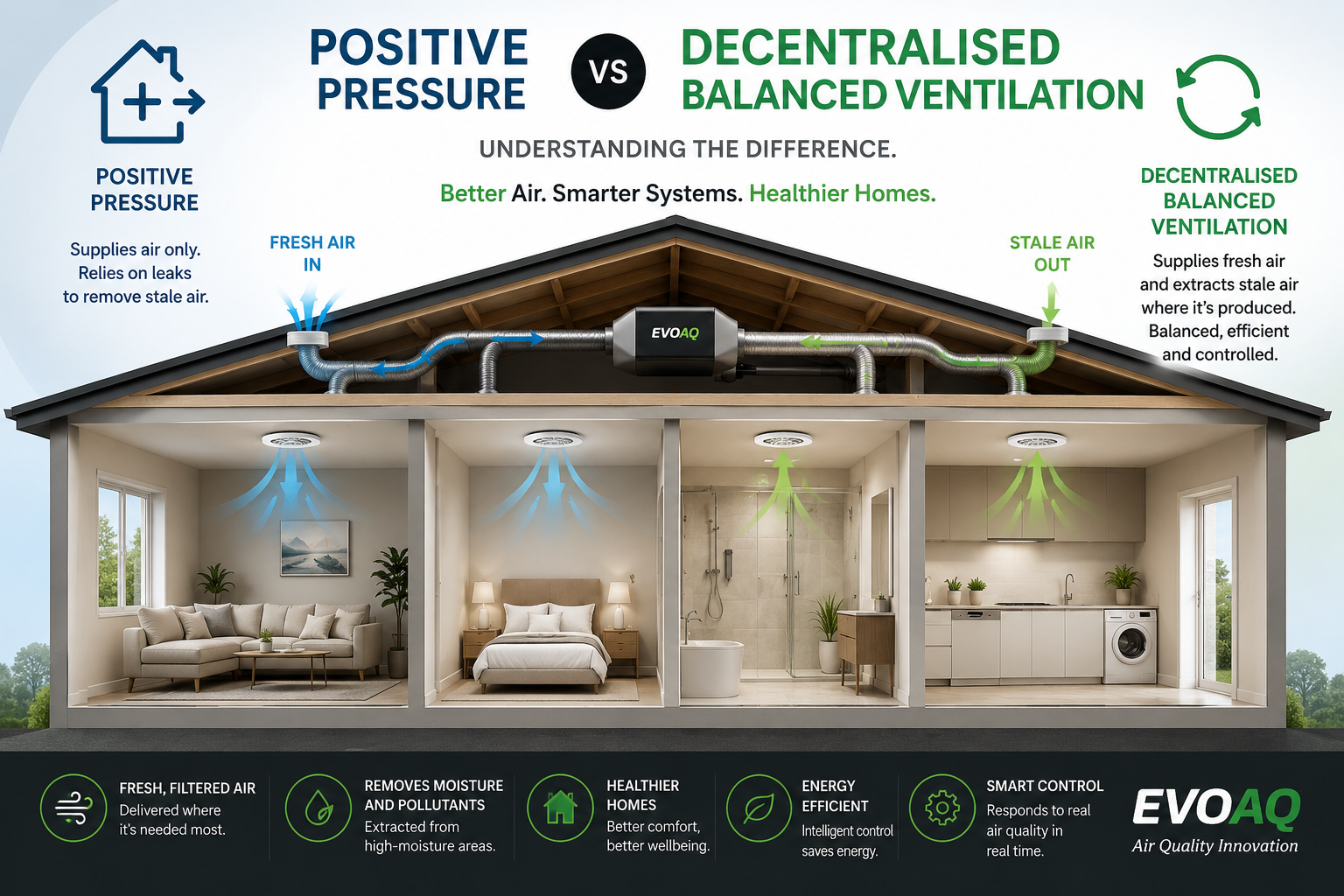
Ventilation is the controlled movement of air into and out of a home. The aim is to bring in suitable outdoor air while removing moisture, pollutants and stale air.
EVOAQ takes a decentralised balanced approach: fresh filtered air is supplied to living and sleeping areas while stale or moisture-laden air is extracted from service areas.
Positive Pressure Ventilation
A positive-pressure system mechanically supplies air into the home. The incoming air increases the pressure inside the building slightly, encouraging air to leave through gaps, openings and other available leakage paths.
- Fresh air is mechanically supplied to the home.
- Air leaves through the building envelope or other available pathways.
- The amount and distribution of incoming air depend heavily on system design.
- The home's airtightness affects how air moves through the building.
Balanced Ventilation
In conventional terminology, a balanced ventilation system mechanically supplies fresh outdoor air and mechanically extracts stale indoor air. The two airflows are designed to operate together rather than relying primarily on uncontrolled leakage.
At EVOAQ, our balanced approach is decentralised. Instead of relying on one central fan and one large network of ducts to move air around the whole house, the supply and extraction functions are distributed through the home.
Fresh filtered outdoor air can be supplied directly to living and sleeping areas, while stale or moisture-laden air is extracted from service areas such as bathrooms, laundries and kitchens.
The important point is that decentralised does not mean uncontrolled. Each part of the system can be designed around the room, its use and its airflow requirement.
Positive Pressure vs Decentralised Balanced Ventilation
| Positive pressure | EVOAQ decentralised balanced | |
|---|---|---|
| Fresh air supply | Mechanical supply | Mechanical supply directly to selected rooms |
| Stale/moist air removal | Primarily through leakage and available openings | Mechanical extraction from selected service areas |
| Airflow path | Depends on building leakage and internal pathways | Designed around supply and extraction locations |
| Roof-space dependence | May be used, depending on system | Fresh air can be sourced directly from outside |
| Room-by-room control | Depends on system design | Distributed system allows targeted airflow control |
| Heat recovery | Not inherent | Not inherent — decentralisation and heat recovery are separate choices |
| Airtight homes | Performance needs careful consideration | Can be designed for controlled supply and extraction in airtight homes |
Why Remove Moisture at the Source?
Bathrooms, laundries and kitchens can produce large amounts of moisture. Extracting humid air close to where it is generated can reduce the amount of moisture that spreads through the rest of the home.
- Bathrooms and showers create concentrated moisture loads.
- Laundries can release significant moisture when clothes are dried.
- Kitchen extraction can remove moisture and cooking pollutants at source.
What About Airtight New Homes?
Airtightness changes the ventilation equation. In a leaky house, uncontrolled air movement can be significant. In a more airtight house, you have greater control over where ventilation air enters and leaves — but you also have less accidental ventilation.
- Airtight homes need deliberate ventilation.
- Controlled supply and extraction can make airflow more predictable.
- The ventilation design should match the building and its occupancy.
So Which System Is Best?
There is no single ventilation system that is best for every New Zealand home. The correct choice depends on the building and the problem you are trying to solve.
- Older, less airtight homes may suit a well-designed positive-pressure system.
- Newer, more airtight homes need deliberate control of both incoming and outgoing air.
- Moisture-heavy rooms benefit from extraction close to the moisture source.
- Limited roof space or difficult central duct routes can favour a decentralised approach.
- Heat recovery may be appropriate where reducing ventilation heat loss is a priority.
Common Mistakes When Comparing Ventilation Systems
The label on a ventilation system does not tell the whole story.
- Choosing only on purchase price.
- Assuming all positive-pressure systems work the same way.
- Treating balanced ventilation and heat recovery as the same thing.
- Ignoring where the fresh air actually comes from.
- Ignoring where moisture and stale air are extracted.
- Comparing fan capacity without considering airflow distribution.
The EVOAQ Philosophy
EVOAQ is designed around a simple principle: put fresh air where people need it and remove stale, humid air where it is produced.
- Decentralised airflow distribution.
- Fresh filtered air supplied to occupied areas.
- Extraction concentrated where moisture and pollutants are generated.
- Intelligent control rather than treating every room and every moment as identical.