Humidity, Relative Humidity & Dew Point
The simple science behind moisture, condensation and indoor air quality in New Zealand homes.
Quick Answer
Relative humidity tells you how close air is to saturation at its current temperature. Dew point tells you the temperature at which condensation can occur. In a New Zealand home, understanding both helps explain why cold windows and other surfaces become wet even when the room air itself looks normal.
Key Terms
Absolute humidity: The actual amount of water vapour present in a volume of air.
Relative humidity: The amount of water vapour in air relative to the maximum it could hold at its current temperature.
Dew point: The temperature at which air becomes saturated and condensation can begin.
New Zealand Home Example
If a bedroom cools overnight while the amount of water vapour stays similar, relative humidity can rise. If the inside of a window reaches the dew point, condensation can form on the glass.
EVOAQ Answer
EVOAQ uses temperature, humidity and moisture behaviour together rather than treating a single RH reading as the complete diagnosis. Ventilation is used to manage the moisture load; heating helps keep air and surfaces warmer.
At a Glance
| Condition | What happens |
|---|---|
| More moisture at same temperature | Relative humidity rises and dew point rises |
| Same moisture, lower temperature | Relative humidity rises |
| Surface reaches dew point | Condensation can form |
| Ventilation removes moist air | Indoor moisture load can be reduced |
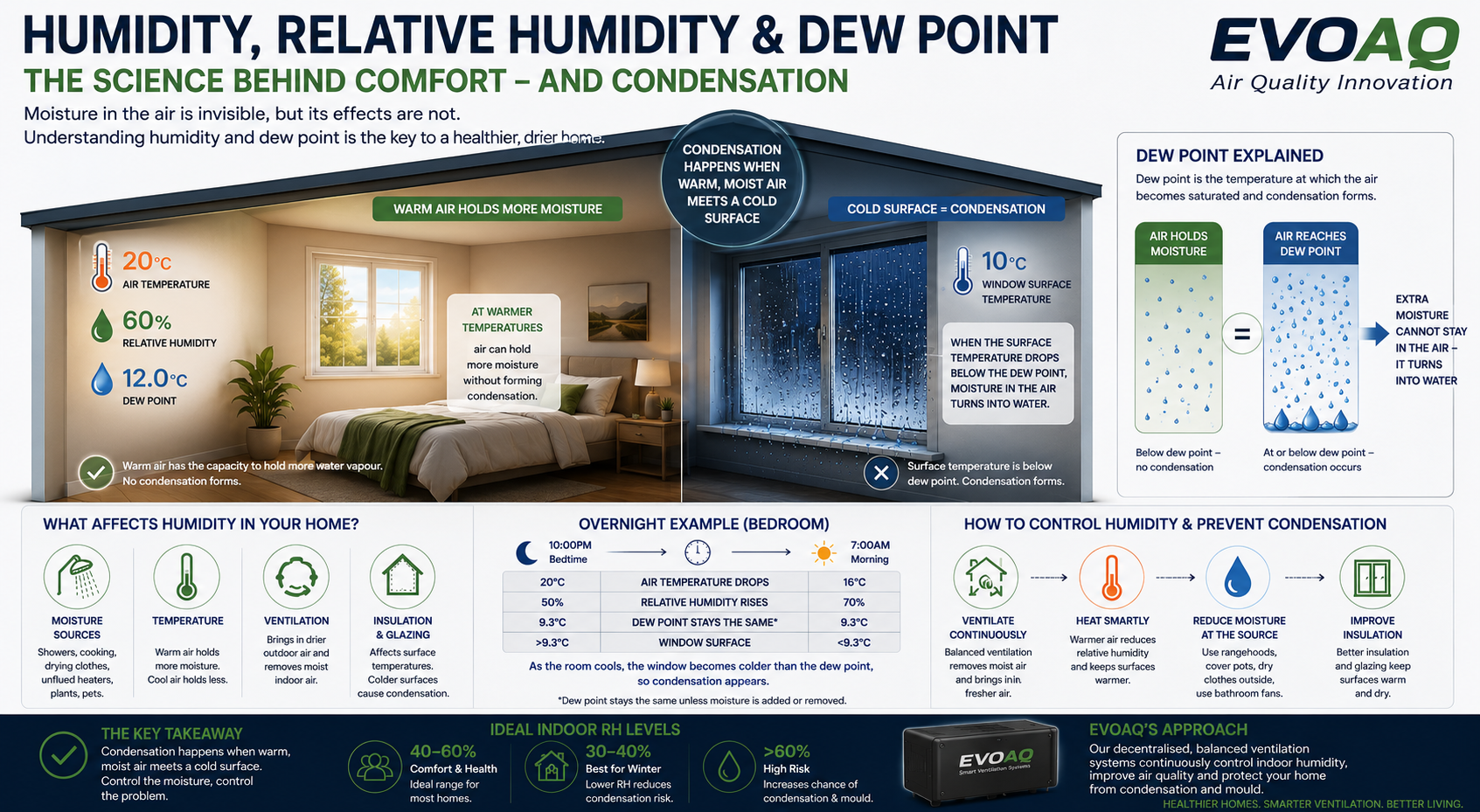
Humidity is one of the most misunderstood parts of indoor air quality. Relative humidity can change simply because temperature changes, even when the actual amount of water vapour in the air has not changed.
Understanding absolute humidity, relative humidity and dew point makes condensation much easier to understand — and explains why warming a room, removing moisture and ventilating a home all play different roles.
First: What Do We Mean by Humidity?
Humidity describes water vapour in the air. Water vapour is invisible, but it is constantly being added to indoor air by people, showers, cooking, drying clothes and other activities.
The important distinction is that the amount of water vapour and the way we express humidity are not the same thing. That is where absolute humidity and relative humidity become useful.
- Absolute humidity describes the actual amount of water vapour in a volume of air.
- Relative humidity describes how much moisture the air contains compared with the maximum it could hold at that temperature.
- Relative humidity therefore changes when temperature changes.
Relative Humidity Is Temperature-Dependent
Relative humidity is a percentage, but it is not a simple measure of how many grams of water are in the room. Warm air can hold more water vapour than cold air, so the same amount of moisture can produce different relative humidity readings at different temperatures.
This is why a room can show a higher relative humidity after it cools overnight even though nobody has added water to the air. The air's moisture content may be almost unchanged while its capacity to hold water vapour has fallen.
- Warm air + the same moisture = lower relative humidity.
- Cooler air + the same moisture = higher relative humidity.
- Heating can therefore reduce RH without removing moisture.
- Ventilation or dehumidification is what actually removes moisture from the home.
A Simple Example: Why RH Rises When a Room Cools
Imagine a bedroom contains the same amount of water vapour at bedtime and in the early morning. If the bedroom cools overnight, its relative humidity can rise because colder air has a lower moisture-holding capacity.
This is one reason bedrooms can experience high humidity and condensation in winter. People also add moisture simply by breathing while asleep.
- The moisture did not necessarily appear because the room became 'wetter'.
- The temperature changed, so the relative humidity changed.
- If the room is cold enough, surfaces such as windows can fall below the dew point and condensation can form.
So What Is the Dew Point?
The dew point is the temperature at which air becomes saturated with water vapour. If a surface is at or below the dew point of the surrounding air, water vapour can condense on that surface.
This is the key connection between humidity and condensation. Relative humidity tells you how close the air is to saturation at its current temperature. Dew point tells you the temperature at which condensation becomes possible.
- Higher moisture content generally means a higher dew point.
- Lowering the room temperature can bring surfaces closer to the dew point.
- A cold window can reach the dew point before warmer parts of the room.
- Condensation is therefore a surface-temperature problem as well as a moisture problem.
Why Windows Are Often the First Warning Sign
Windows are frequently among the coldest surfaces in a room, particularly in winter. If indoor air has a high enough dew point, the inside of the glass can reach that temperature and condensation appears.
The water on the window is useful information: it tells you that the combination of indoor moisture and surface temperature has reached a point where condensation can occur.
- Condensation on glass does not mean the glass created the moisture.
- The moisture was already in the indoor air.
- The cold glass simply provided a surface where that moisture could become liquid.
Relative Humidity Is Not the Whole Story
A single RH number does not tell the complete story of a home. Two rooms can have the same relative humidity but very different temperatures and therefore different dew points.
Surface temperature also matters. Insulation, glazing, thermal bridges, room heating and air movement can all affect whether a particular surface becomes cold enough for condensation.
- Indoor temperature
- Relative humidity
- Dew point
- Surface temperature
- Air movement
- Insulation and glazing
What Happens When You Heat the Air?
Heating is useful because warmer air and warmer surfaces reduce condensation risk. If the amount of water vapour stays the same while the air temperature rises, relative humidity falls.
But this distinction is important: heating changes temperature; it does not remove the water vapour. If moisture continues to be generated, the moisture load remains in the home.
- Heating can lower RH.
- Heating can raise surface temperatures.
- Heating does not remove water vapour.
- Ventilation removes humid air and replaces it with outdoor air.
What Happens When You Ventilate?
Ventilation changes the moisture balance by removing indoor air and replacing it with outdoor air. The result depends on the temperature and moisture content of the incoming air, but controlled ventilation provides a way to continuously manage moisture rather than waiting for visible condensation.
Building Performance recommends venting moisture at the source, reducing moisture generation and ensuring the home is well ventilated. It also identifies continuous mechanical ventilation as an effective way to maintain fresh air.
- Extract moisture from bathrooms, laundries and kitchens.
- Bring fresh outdoor air into occupied areas.
- Use continuous or appropriately controlled ventilation rather than relying only on occasional window opening.
- Do not use roof-space air as the source of ventilation air.
Humidity, Dew Point and Mould
Condensation and mould are related, but they are not the same thing. You do not need to see water running down a window before a room can become a poor environment for building materials and mould growth.
BRANZ research has found that temperature and relative humidity are important factors influencing comfort and health, with cold temperatures and excessive moisture associated with mould growth.
- Repeatedly high humidity can increase moisture-related problems.
- Cold surfaces can create localised high-moisture conditions.
- Keeping a home warm, dry and well ventilated helps reduce the conditions that support mould.
What Relative Humidity Should a Home Have?
There is no single RH number that guarantees a healthy home in every situation. Temperature, building materials, surface temperatures, occupancy and ventilation all matter.
As a practical moisture-management approach, persistently high indoor RH should be treated as a warning rather than chasing one perfect number. Building Performance notes that humidity greater than 70% creates favourable conditions for mould growth, while its current technical guidance identifies increased condensation risk above about 60% RH and greater microbial-growth likelihood above about 65% under the relevant conditions.
- Use RH as an indicator, not the only measure.
- Look at RH together with temperature and dew point.
- Investigate repeated high readings rather than relying on a single snapshot.
- If condensation is occurring, act on the moisture and surface-temperature conditions causing it.
The EVOAQ Approach: Control the Moisture, Not Just the Number
EVOAQ's approach is to manage the conditions that create poor indoor air quality rather than chasing a single humidity number. Moisture is generated in predictable places, and ventilation should respond to the way the home is actually used.
Our decentralised balanced ventilation concept supplies fresh filtered outdoor air to occupied areas while extracting stale and moisture-laden air from service areas such as bathrooms, laundries and kitchens.
The objective is simple: reduce the time moisture remains in the home, remove moisture close to where it is generated, and provide controlled fresh air without relying entirely on someone remembering to open a window.
- Fresh filtered air to living and sleeping areas.
- Extraction where moisture is generated.
- Decentralised airflow distribution.
- Continuous control rather than occasional ventilation.
The Practical Takeaway
If you remember only one thing, remember this: relative humidity tells you how close the air is to saturation at its current temperature; dew point tells you the temperature at which condensation can occur.
That makes condensation easier to understand. You can reduce the risk by controlling moisture, keeping rooms and surfaces warmer, and providing effective ventilation.
- Reduce moisture at the source.
- Keep the home reasonably warm.
- Keep cold surfaces warmer with good insulation and glazing.
- Ventilate continuously or effectively.
- Use temperature, RH and dew point together when diagnosing a moisture problem.
New Zealand Research & Guidance
This page draws on New Zealand research and government guidance about indoor moisture, temperature, relative humidity, mould and ventilation.
From Humidity to Condensation
Now that you understand relative humidity and dew point, the next step is understanding what causes condensation in real New Zealand homes — and what can be done about it.