What Causes Condensation in a New Zealand Home?
Why condensation happens, why it returns, and how to create a drier home.
Quick Answer
Condensation occurs when moisture-laden indoor air meets a surface cold enough for the water vapour to condense. The recurring problem is usually a combination of indoor moisture, cold surfaces and insufficient moisture removal — not the window itself.
Key Terms
Condensation: Water vapour changing from gas to liquid when the relevant temperature and moisture conditions are reached.
Dew point: The temperature at which air becomes saturated with water vapour.
Thermal bridge: A part of the building envelope where heat flows more readily than through surrounding areas, potentially creating a colder surface.
New Zealand Home Example
A family can produce substantial moisture from showers, cooking, breathing and drying clothes. If a bedroom is cool and poorly ventilated overnight, the moisture can remain indoors and cold glazing can reach the dew point.
EVOAQ Answer
EVOAQ's approach is to reduce the moisture load, remove moisture-laden air, and maintain suitable room and surface temperatures. Ventilation is part of a broader moisture-management strategy, not a replacement for insulation or heating.
At a Glance
| Cause | Effect on condensation risk |
|---|---|
| More indoor moisture | Raises moisture content and dew point |
| Lower room temperature | Can raise RH and cool surfaces |
| Cold glazing/surfaces | Can reach dew point sooner |
| Effective ventilation | Removes moisture-laden indoor air |
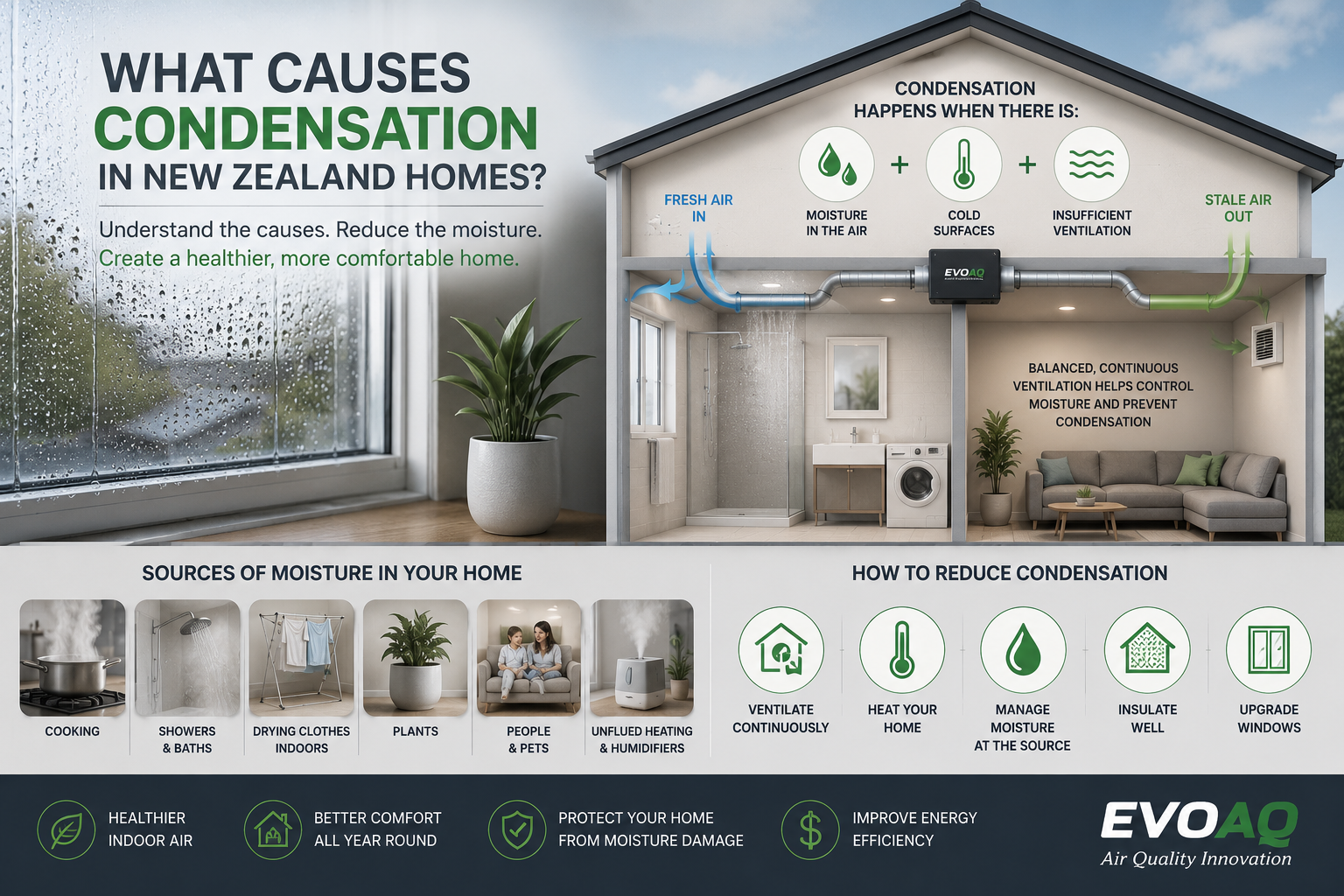
Condensation is one of the most visible signs that a home is struggling to manage moisture. It forms when moisture-laden indoor air meets a surface that is cold enough for water vapour to turn into liquid.
The lasting answer is not simply wiping the windows. It is understanding where the moisture comes from, keeping rooms and surfaces reasonably warm, and removing humid air through effective ventilation.
Condensation Is a Moisture Problem — Not Just a Window Problem
Condensation occurs when water vapour in indoor air reaches a surface that is colder than the air's dew point. The vapour then changes from a gas into liquid water on that surface.
Windows are often where condensation is first noticed because glass can be one of the coldest surfaces in a room. But the same process can occur on cold corners, frames, ceilings, behind furniture and other cold or poorly ventilated areas.
The Three Things That Create Condensation
Three conditions come together: moisture in the indoor air, a sufficiently cold surface, and air that reaches its dew point at that surface.
- More indoor moisture increases the risk.
- Colder windows and building surfaces increase the risk.
- Poor ventilation allows moisture to remain in the home.
- Heating can reduce relative humidity and warm surfaces, but heating alone does not remove moisture.
Where Does the Moisture Come From?
Moisture is being added to a home throughout the day. People breathe and perspire, showers create steam, cooking releases water vapour and clothes drying indoors can add a surprisingly large amount of moisture.
New Zealand Building Performance guidance gives useful examples: cooking can produce around 3 litres of moisture per day, a shower or bath around 1.5 litres per person, dishes around 1 litre, and an unvented load of clothes drying around 5 litres. Unflued gas heaters can also add significant moisture directly to the room.
- Showering and bathing
- Cooking and boiling water
- Drying clothes indoors
- Breathing and normal occupancy
- Unflued gas heating
- Leaks, damp ground or moisture entering from the building
Why Modern New Zealand Homes Can Still Get Condensation
Better insulation and airtightness are good things. They make a home easier to heat and give the designer greater control over where ventilation air enters and leaves.
But airtightness also means moisture produced inside the home does not disappear through accidental draughts as readily. BRANZ research has found that newer homes are becoming more airtight while many homes are still under-ventilated.
This is why a warm, well-insulated home can still have condensation if the moisture generated by occupants is not removed.
- Airtight homes need deliberate ventilation.
- Insulation helps keep surfaces warmer but does not remove moisture.
- Heating makes a home warmer but does not remove moisture.
- Ventilation is what actually removes humid indoor air.
Why Spot Heating Can Make Condensation Worse
Many New Zealand homes are heated mainly in the living room, often for only part of the day. BRANZ research identifies spot heating as common in New Zealand homes.
A warm living room can be comfortable while bedrooms, hallways and other rooms remain much colder. When humid air moves into those colder spaces, surfaces can reach the dew point more easily.
Keeping the home reasonably warm and avoiding very cold rooms can therefore be an important part of moisture management.
Why Opening a Window Helps — But Isn't Always the Whole Answer
Opening windows can remove moisture quickly when outdoor conditions are suitable. The limitation is consistency: windows depend on someone remembering to open them, and people are naturally less inclined to open windows when it is cold, wet, windy, noisy or security is a concern.
Mechanical ventilation provides a more consistent way of exchanging indoor air without relying entirely on occupant behaviour.
The Best Way to Control Condensation
The most effective strategy is to deal with moisture as close as possible to its source, then ventilate the remaining moisture from the home. Building Performance guidance recommends reducing moisture sources, venting moisture to outside and ensuring the home is well ventilated.
Heating and insulation are important because warmer rooms and warmer surfaces reduce the conditions that allow condensation to form. They work together with ventilation rather than replacing it.
- Reduce unnecessary moisture generation.
- Extract moisture directly from bathrooms, laundries and kitchens.
- Provide controlled fresh-air ventilation throughout the home.
- Keep rooms and surfaces reasonably warm.
- Improve insulation and glazing where cold surfaces are a problem.
- Use a dehumidifier as a supplementary tool where appropriate — not as the only moisture strategy.
Why Ventilation Makes Such a Difference
Ventilation changes the amount of water vapour in the indoor air. When humid indoor air is removed and replaced with outdoor air, the moisture load of the home can be reduced.
BRANZ research into New Zealand homes found that increasing ventilation reduced how long moisture remained in the air. Ventilation works best as part of a broader moisture-management strategy.
- Remove humid air.
- Bring in outdoor air.
- Reduce the time moisture remains in the home.
- Control moisture continuously rather than waiting for condensation to appear.
EVOAQ's Approach to Condensation
EVOAQ approaches condensation as an indoor moisture-management problem. Our decentralised balanced ventilation concept supplies fresh filtered outdoor air to the rooms where people live and sleep, while extracting stale and moisture-laden air from service areas.
The objective is not simply to move air around the house. It is to control the air that matters: bring in fresh outdoor air, remove humid air where it is generated, and provide ventilation consistently as conditions change.
- Fresh air supplied to occupied areas.
- Moisture extracted close to where it is produced.
- Decentralised airflow distribution.
- Continuous ventilation without requiring someone to remember to open a window.
Condensation: What You See May Not Be the Real Problem
A wet window is easy to see, so it often becomes the focus of attention. But the real issue may be the moisture balance of the whole home.
If condensation is appearing repeatedly, especially on several windows or in different rooms, look beyond the glass. Check indoor humidity, room temperatures, ventilation, moisture sources and cold surfaces.
If moisture is appearing inside walls, ceilings or other building cavities rather than on visible surfaces, the problem can be different and may require investigation of the building envelope, leaks, insulation and vapour movement.
New Zealand Research & Guidance
The information on this page is informed by New Zealand research and government guidance on internal moisture, ventilation, heating and condensation.
What Should You Do Next?
If condensation is a recurring problem, start by identifying where moisture is being generated and where humid air is failing to escape from the home.
For a deeper explanation of EVOAQ's decentralised balanced approach, see our guide to Positive Pressure vs Decentralised Balanced Ventilation.
Read: Positive Pressure vs Decentralised Balanced Ventilation